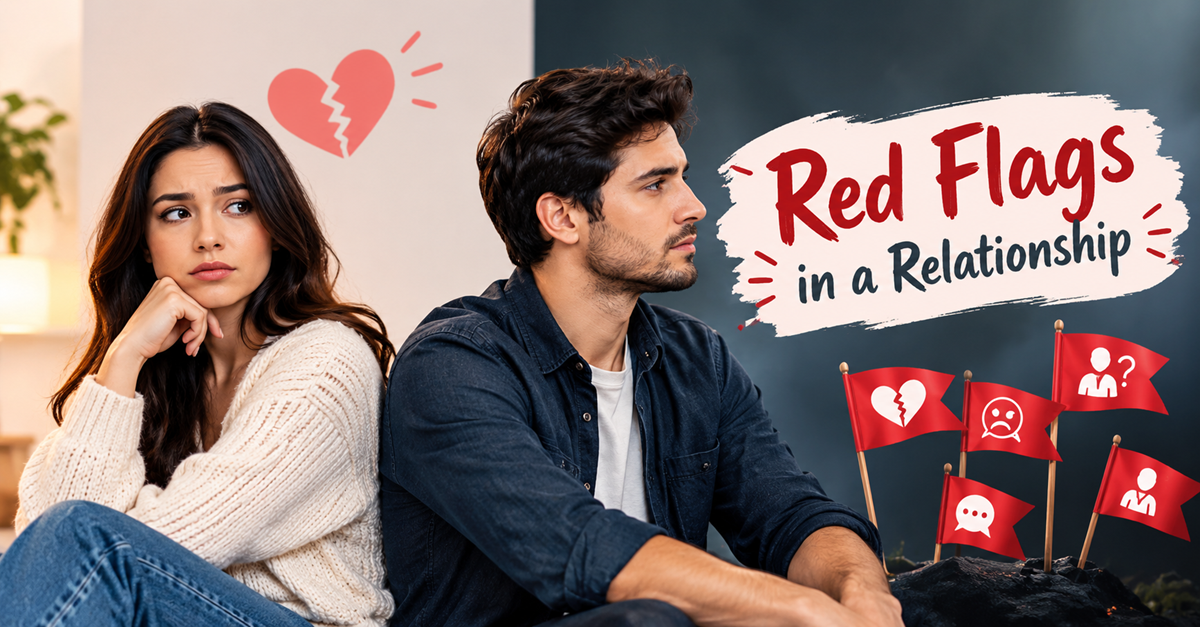
You come home after a normal day and notice that you are already worried about what your partner might say. Maybe you are nervous about mentioning that you met a friend, using your phone, going out alone, or simply asking for some personal space.
Nothing dramatic has happened today, yet you still feel uncomfortable. This is often how relationship problems begin. They do not always arrive as one huge argument or obvious act of cruelty.
Sometimes they appear as small changes that slowly become part of everyday life. If you often feel confused, controlled, guilty, or afraid of upsetting your partner, it is worth paying attention to those feelings and looking closely at the pattern.
What Are Red Flags in a Relationship
Red flags in a relationship are repeated behaviors that can point toward unhealthy communication, disrespect, manipulation, control, or abuse. A single bad conversation does not automatically mean that your relationship is unhealthy.
People make mistakes, lose their temper, misunderstand each other, and sometimes say things they regret. The bigger question is what happens regularly and how your partner responds when you explain that something has hurt you.
Do they listen, accept responsibility, and try to improve, or do they dismiss your feelings and make the same behavior happen again. Understanding this difference can help you avoid ignoring serious relationship problems simply because you still love the person.
You Feel Like You Have to Ask for Permission
One common relationship red flag is when your partner slowly starts controlling ordinary parts of your life. At first, it may sound like concern. They may ask where you are going, who you will meet, when you will return, and why you need to go without them.
There is a difference between asking because someone cares and demanding information because they expect control. If you feel that you need permission before meeting friends, visiting family, choosing clothes, spending your own money, or making everyday decisions, stop and look at the pattern.
A healthy relationship allows two people to remain individuals. Being in love does not mean giving another person control over every part of your life.
Constant Jealousy Can Destroy Trust
Jealousy can happen even in loving relationships, but repeated jealousy can become a serious problem when it turns into suspicion and control. Your partner may question every message you receive, become angry when you speak to a colleague, or accuse you of cheating without a reasonable reason.
They might check your phone while you are sleeping or expect you to explain every person who likes your social media posts. Over time, you may stop talking to certain people simply because you want to avoid another argument.
That is not a healthy solution. Trust cannot grow when one person is constantly being investigated. A healthy relationship gives both people reasonable freedom while allowing honest conversations about genuine concerns.
Your Boundaries Are Not Being Respected
A boundary is simply a clear statement about what you are comfortable with and what you are not comfortable with. It could involve personal space, physical affection, communication, money, family, friendships, privacy, or intimacy.
One of the biggest warning signs of an unhealthy relationship is when you clearly communicate a boundary and your partner repeatedly ignores it. Imagine telling your partner that you need some quiet time after work, but they keep calling, showing up unexpectedly, or accusing you of avoiding them.
Another important example involves physical intimacy. Saying no should always be respected. Nobody should pressure you, guilt you, threaten you, or repeatedly push you after you have said no.
You Are Always Walking on Eggshells
Pay attention if you constantly think about how your partner will react before you speak. You may carefully choose simple words, avoid certain topics, hide normal activities, or change your plans because you are worried about an argument.
Perhaps you know that mentioning a particular friend will cause jealousy or that disagreeing about money will lead to hours of anger. Living this way can be emotionally exhausting because you are always managing another person’s reaction.
Relationships naturally involve disagreements, but disagreement should not make you feel unsafe or frightened. If you regularly feel that one wrong sentence could cause a major problem, that pattern deserves attention rather than being dismissed as normal relationship stress.
Your Partner Makes You Feel Small
A healthy partner can tell you that they disagree with you without making you feel worthless. Repeated insults, humiliation, mocking, and personal criticism can slowly damage confidence. Sometimes these comments are disguised as jokes.
Your partner may make fun of your appearance, intelligence, career, family, body, or personality and then say that you cannot take a joke when you become upset. One awkward joke does not tell the whole story.
Repeatedly using humiliation to make you feel inferior is different. If you notice that you are becoming quieter, less confident, or afraid to express your opinion because of your partner’s comments, take that change seriously. Respect should remain present even during difficult conversations.
Gaslighting Can Make You Doubt Your Own Memory
One of the more confusing signs of emotional manipulation is gaslighting. This can happen when someone repeatedly denies things that happened, changes the meaning of previous conversations, or tells you that your feelings and memories cannot be trusted.
Imagine your partner clearly promised to call you after work. When you later mention that they never called, they insist that you imagined the conversation. If this happens once, memory may simply be imperfect. If it happens repeatedly and you constantly end up questioning yourself, the situation is different.
You may start keeping screenshots, replaying conversations in your mind, or asking friends whether you are imagining problems. That growing self doubt is something worth noticing.
Relationship Red Flags You Should Never Ignore
Some warning signs should never be ignored. If your partner controls you, isolates you, ignores your boundaries, monitors your phone, or makes you feel afraid, it is time to take the behavior seriously.
If you keep changing your behavior just to avoid arguments, pay attention. Relationship Red Flags You Should Never Ignore can affect your freedom, privacy, confidence, safety, and ability to make your own choices. Looking at the overall pattern can help you understand the situation clearly.
Your Partner Isolates You From People You Trust
Relationships become unhealthy when one person gradually cuts the other person off from friends and family. The behavior may begin with comments such as your friends do not really care about you or your family does not understand our relationship.
Later, your partner may start creating arguments before you meet them, become angry after you spend time with them, or demand that you stop talking to certain people. Eventually, you may avoid everyone simply because keeping the peace feels easier.
This can leave you emotionally dependent on one person and make it harder to get an outside perspective. Healthy relationships leave room for friendships, family connections, personal interests, and supportive relationships outside the partnership.
Their Apologies Do Not Bring Real Change
Saying sorry is easy. Changing a repeated behavior is much harder. This is why you should pay attention to what happens after an apology rather than focusing only on the words. Your partner may insult you, become emotional, promise that it will never happen again, and behave lovingly for several days.
Then the same behavior returns. You argue again, receive another apology, and the cycle starts over. This pattern can become confusing because the good periods may make you believe everything has finally changed.
Real improvement usually becomes visible through consistent behavior over time. If the same harmful action keeps returning after repeated apologies, the pattern matters more than the promise.
They Blame You for Their Bad Behavior
A major warning sign is when your partner makes you responsible for their actions. They may say that they shouted because you made them angry, checked your phone because you gave them a reason to be suspicious, or insulted you because you refused to listen.
People can influence each other’s emotions, but each person remains responsible for how they behave. Being angry does not force someone to threaten another person. Feeling jealous does not force someone to control a partner.
When someone repeatedly explains their behavior by blaming you, it becomes difficult to solve the actual problem because responsibility keeps moving away from the person who acted badly. Healthy communication requires accountability from both people.
Money Should Not Become a Control Tool
Money can naturally create disagreements in relationships, especially when partners have different incomes, spending habits, or financial responsibilities. The problem becomes more serious when one person deliberately uses money to control the other.
A partner might prevent you from working, take your earnings, control access to shared money, demand explanations for every purchase, or make you financially dependent on them. They may also use debt or financial pressure to make you feel that leaving the relationship is impossible.
Couples can choose different ways to manage finances, and there is no single correct system for every household. The important point is that financial decisions should not be used to remove another person’s independence or ability to make reasonable choices.
Threats and Intimidation Should Never Be Ignored
Threats are among the most serious relationship warning signs. A threat does not always involve directly saying that someone will be physically hurt. It can involve threatening to hurt themselves, damage your property, harm someone you love, hurt a pet, expose private information, or make your life difficult if you leave.
Intimidation can also include breaking objects, punching walls, blocking a doorway, driving dangerously during an argument, or deliberately using fear to stop you from speaking. You do not have to wait for physical violence before taking threatening behavior seriously.
If you believe that confronting your partner or ending the relationship could put you in danger, focus on your safety and consider reaching out to a trusted person or professional support service.
How Can You Tell If It Is a Real Relationship Red Flag
Look for repeated patterns instead of judging one incident. Ask yourself if the behavior keeps happening, becomes worse over time, makes you afraid to disagree, or if your partner refuses to take responsibility.
Also notice what happens to your life outside the relationship. Are you seeing friends less often. Are you hiding ordinary activities. You constantly checking your phone because you are afraid of your partner’s reaction.
Are you changing your personality just to avoid conflict. These questions can help you see the difference between an ordinary relationship problem and a pattern that is damaging your freedom, confidence, trust, or sense of safety.
What Should You Do When You Notice These Warning Signs
You do not have to make every decision immediately. Start by taking your concerns seriously and writing down specific situations if that helps you understand what is happening.
Focus on facts such as what was said, what happened before the argument, how your partner responded, and whether the same behavior has happened before. If you feel safe doing so, speak with someone you trust and explain the situation honestly.
A close friend, family member, counselor, or qualified support service may notice things that are difficult to see when you are emotionally involved. If there are threats, violence, stalking, sexual pressure, or serious control, do not assume that a confrontation is always the safest choice.
What Does a Healthy Relationship Actually Look Like
Knowing what healthy behavior looks like can make unhealthy behavior easier to recognize. A healthy relationship does not mean that two people agree about everything or never argue. It means both people can disagree without using fear, insults, threats, or control.
You should be able to spend time with friends, have personal interests, express an opinion, maintain reasonable privacy, and say no without being punished. Both partners should be able to apologize, accept responsibility, and make changes when their behavior causes harm.
There should also be room for individuality. Love should not require you to lose your identity. A strong relationship can include closeness and independence at the same time.
When You Should Take Your Feelings Seriously
Sometimes people ignore red flags because the relationship also has wonderful moments. Your partner may be caring, funny, supportive, and affectionate at certain times while behaving in controlling or hurtful ways at other times.
Good memories do not automatically cancel harmful patterns. You also do not need to prove that someone is a bad person before deciding that certain behavior is unacceptable to you. Your feelings are information.
If you repeatedly feel anxious, controlled, isolated, pressured, confused, or afraid, pause and examine why. You do not have to ignore these feelings simply because the relationship has good moments. Recognizing a problem early can give you more time to think clearly about your boundaries, support system, and next steps.
Red Flags Are About Patterns, Not Perfection
No relationship is perfect, and no person behaves perfectly all the time. The goal is not to find someone who never makes a mistake. The goal is to recognize whether problems can be discussed, whether boundaries are respected, and whether both people are willing to take responsibility and improve.
Red flags become more concerning when the same behavior keeps happening and your attempts to address it lead to more blame, fear, control, or isolation. If something feels wrong, you do not have to ignore it simply because the relationship has good moments.
Pay attention to repeated behavior, protect your boundaries, stay connected to people you trust, and remember that a healthy relationship should allow you to feel respected, safe, and free to be yourself.
About Today Guides
TodayGuides provides simple, practical, and easy-to-understand guides on relationships, dating, personal growth, and everyday life. Our content is designed to help readers solve real-life problems, make better decisions, and improve their daily lives with clear, actionable advice.
Controlling behavior, constant jealousy, disrespect, manipulation, isolation, threats, and repeated boundary violations are common warning signs.
Occasional jealousy can be normal. It becomes a red flag when it leads to accusations, phone checking, control, or restrictions on your friendships.
Look for repeated patterns that make you feel afraid, controlled, disrespected, isolated, or unable to express yourself freely.
Some problems can improve when both partners accept responsibility and make consistent changes. Repeated abuse, threats, or serious control should be taken especially seriously.
Talk to someone you trust, set clear boundaries when it is safe, and seek professional support if the behavior involves threats, abuse, or serious control.